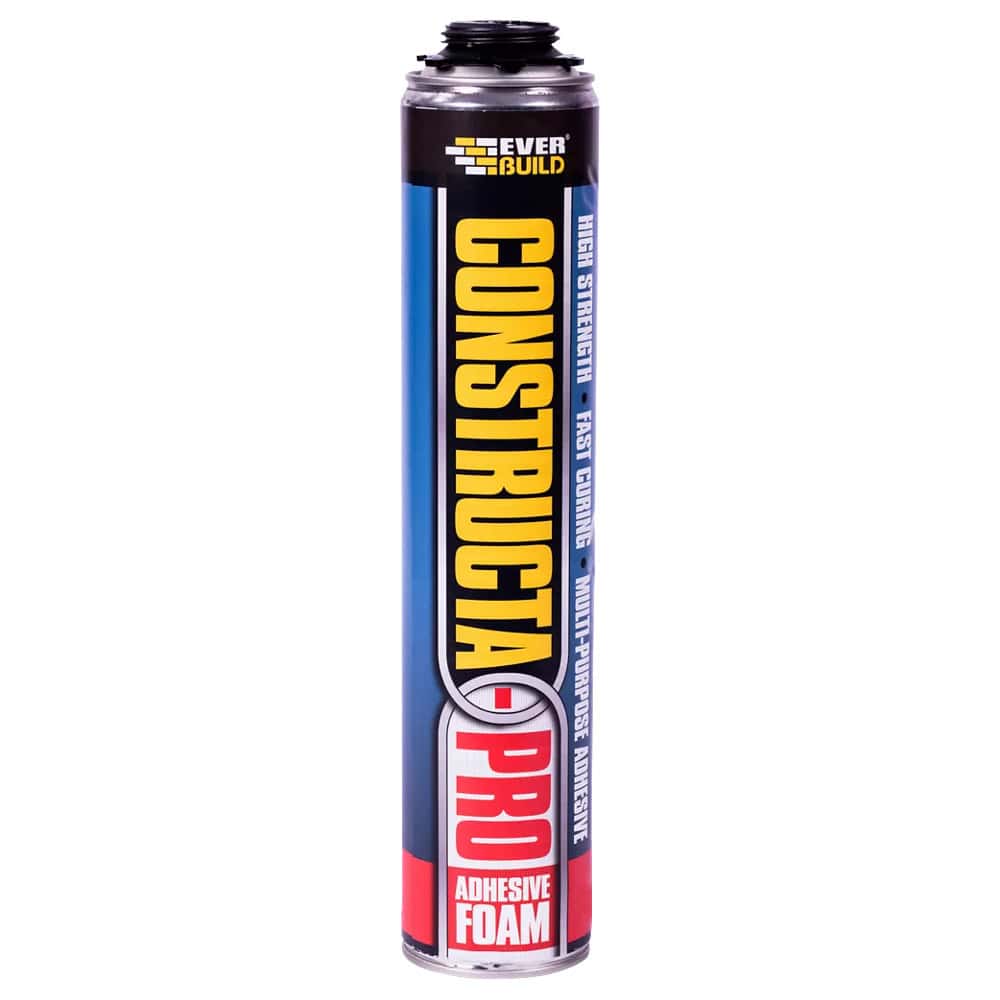
Everbuild Constructa-Pro Foam Adhesive
Everbuild Constructa-Pro Foam Adhesive is a high-performance polyurethane adhesive designed to provide a fast and efficient alternative to traditional bonding methods. Applied as a controlled bead of foam, it is suitable for securing compatible insulation boards, construction panels and other common building materials to properly prepared surfaces.
The aerosol format makes the adhesive quick to dispense and helps reduce the mixing, carrying and cleaning associated with conventional powdered products. It is particularly useful for professional construction, renovation, insulation and dry-lining projects where speed, controlled application and dependable adhesion are important.
Fast and efficient board bonding
Constructa-Pro Foam Adhesive is designed to simplify the installation of compatible construction and insulation boards. The product is applied directly from the can in evenly spaced beads, eliminating the need to prepare a separate wet adhesive mix. This can help save time on site and reduce the amount of water, buckets and mixing equipment required.
The foam consistency allows the adhesive to establish contact across the back of the board while accommodating minor variations in the receiving surface. Once the material has been positioned and pressed into place, the adhesive begins to cure and form a strong bond between the compatible substrates.
The product must not be used to compensate for severely uneven, loose or structurally defective backgrounds. Large hollows and major irregularities should be repaired using an appropriate levelling or repair material before installation begins.
Suitable applications
Everbuild Constructa-Pro Foam Adhesive can be used for a variety of compatible internal building and refurbishment tasks. Typical applications may include bonding insulation boards, plasterboard and selected rigid construction panels to suitable walls and other stable backgrounds.
It can adhere to many commonly encountered materials, including concrete, masonry, brick, blockwork, plaster, timber and selected insulation products. Actual compatibility will depend on the type of board, its facing material and the condition of the receiving surface. A small adhesion test should always be completed when working with an unfamiliar product.
Some plastics and insulation materials can react with conventional solvent-based adhesives. Users must check the board manufacturer’s instructions and confirm compatibility before applying the foam across a complete installation. Do not assume that every foam or plastic board can be bonded with the same adhesive.
Controlled foam application
The foam is dispensed in beads rather than spread over the entire surface. This helps installers control the amount applied and reduces the potential waste associated with mixing more adhesive than a project requires. The aerosol container also keeps the unused material enclosed until it is needed.
Apply the product using the dispensing system specified on the can. If the product requires a compatible foam applicator gun, ensure the gun is securely fitted and in good working order before use. The flow-control adjustment can then be used to produce an appropriate, consistent bead.
Always keep the can in the orientation stated by the manufacturer while dispensing. Incorrect positioning can result in an uneven discharge, reduced yield or propellant escaping without the adhesive.
Surface preparation
Correct preparation is essential for reliable performance. The background must be sound, stable and free from dust, grease, oil, loose material and other contamination. Remove flaking paint, laitance, poorly bonded plaster and weak surface deposits before application.
Boards must also be clean and suitable for adhesive fixing. Remove packaging dust and check that any foil, paper or specialist facing is firmly attached. If the facing itself is loose, the adhesive bond may fail even though the foam remains attached to it.
Protect adjacent surfaces, floors, windows and finished materials before beginning work. Uncured polyurethane foam can be difficult to remove and may permanently mark porous or decorative finishes.
How to apply Constructa-Pro Foam Adhesive
Read the container instructions and wear the recommended personal protective equipment. Shake the can thoroughly for the period specified on the label. Attach the correct dispensing nozzle or compatible applicator gun, taking care not to damage the valve.
Apply the foam in continuous, evenly spaced beads to the board or receiving surface as directed. The bead layout should allow the adhesive to spread without creating an airtight pocket. Include suitable coverage around the perimeter while maintaining the clearances recommended by the manufacturer.
Wait for any specified activation or open time before placing the board. Bring the materials together within the stated working period and press firmly to establish consistent contact. Check alignment immediately and adjust while the adhesive remains workable.
Use a straightedge or level to confirm that boards are flat, correctly positioned and aligned with adjoining pieces. Temporary support may be required for overhead work, heavy panels or surfaces where movement is possible. Do not remove support until the adhesive has developed sufficient strength.
Curing conditions
Polyurethane foam adhesives cure through a reaction with atmospheric and surface moisture. Temperature, humidity, bead thickness and substrate type will therefore affect their working and curing times. Warm, moderately humid conditions generally support faster curing, while cold or very dry environments can slow the process.
Do not disturb or load the bonded materials until the adhesive has cured sufficiently. Any exposed excess should be allowed to harden before it is trimmed carefully. Do not cut or finish the foam prematurely, as this may interfere with the developing bond.
Improved site efficiency
Compared with traditional powdered adhesives, an aerosol foam adhesive can help reduce site preparation and cleaning. There is no mixing bucket to fill, no need to measure powder and water, and less unused mixed material to discard at the end of the application period.
The lightweight can is also convenient to carry around a working area and useful where access is restricted. These benefits can make Constructa-Pro particularly effective for smaller installations, repair work and projects requiring boards to be fixed in several separate locations.
Important limitations
Everbuild Constructa-Pro Foam Adhesive must only be used with compatible materials and in applications permitted by the current manufacturer guidance. It should not automatically be treated as a structural adhesive or a substitute for mechanical anchors, screws or specialist fixings.
Building regulations, system specifications and board manufacturers may require mechanical restraint in addition to adhesive. This is especially important for exterior insulation, overhead installations, fire-rated systems, heavy boards and locations where failure could present a safety risk.
Do not use on weak, dusty, frozen, heavily contaminated or unstable surfaces. Avoid application in standing water or outside the temperature range printed on the product. Compatibility must be checked before use on polyethylene, polypropylene, PTFE, silicone, bitumen or solvent-sensitive materials.
Safe handling
Constructa-Pro is supplied in a pressurised aerosol container. Keep it away from heat, sparks, flames, hot surfaces and other ignition sources. Do not smoke during application and do not pierce or burn the can, even after use.
Use only in a well-ventilated area and avoid inhaling vapour or aerosol. Wear suitable gloves, eye protection and work clothing. Polyurethane foam adheres strongly to skin and hair, so accidental contact should be avoided. Keep the product securely away from children.
Fresh adhesive should be removed using an approved polyurethane foam cleaner, provided that the cleaner is compatible with the affected surface. Fully cured foam will normally require careful mechanical removal. Clean a foam applicator gun immediately after use unless the manufacturer permits a partially used can to remain attached for storage.
Why choose Everbuild Constructa-Pro?
Everbuild Constructa-Pro Foam Adhesive offers a fast, clean and practical approach to compatible board-bonding projects. Its controlled foam application reduces mixing and allows installers to apply only the amount required. The adhesive can accommodate minor background irregularities and bond a range of common construction materials when the surfaces are correctly prepared.
- High-performance polyurethane foam adhesive
- Suitable for compatible insulation and construction boards
- No separate powder-and-water mixing required
- Controlled bead application
- Helps fill minor surface irregularities
- Bonds to many common building materials
- Useful for construction and refurbishment projects
- Reduces equipment and cleaning requirements
Always read the product label and latest Everbuild technical data before use. Confirm board compatibility, observe the recommended application and curing conditions, and install mechanical fixings wherever required by the system specification or building regulations.